
What’s the Best Outboard Motor for a 12ft Boat?

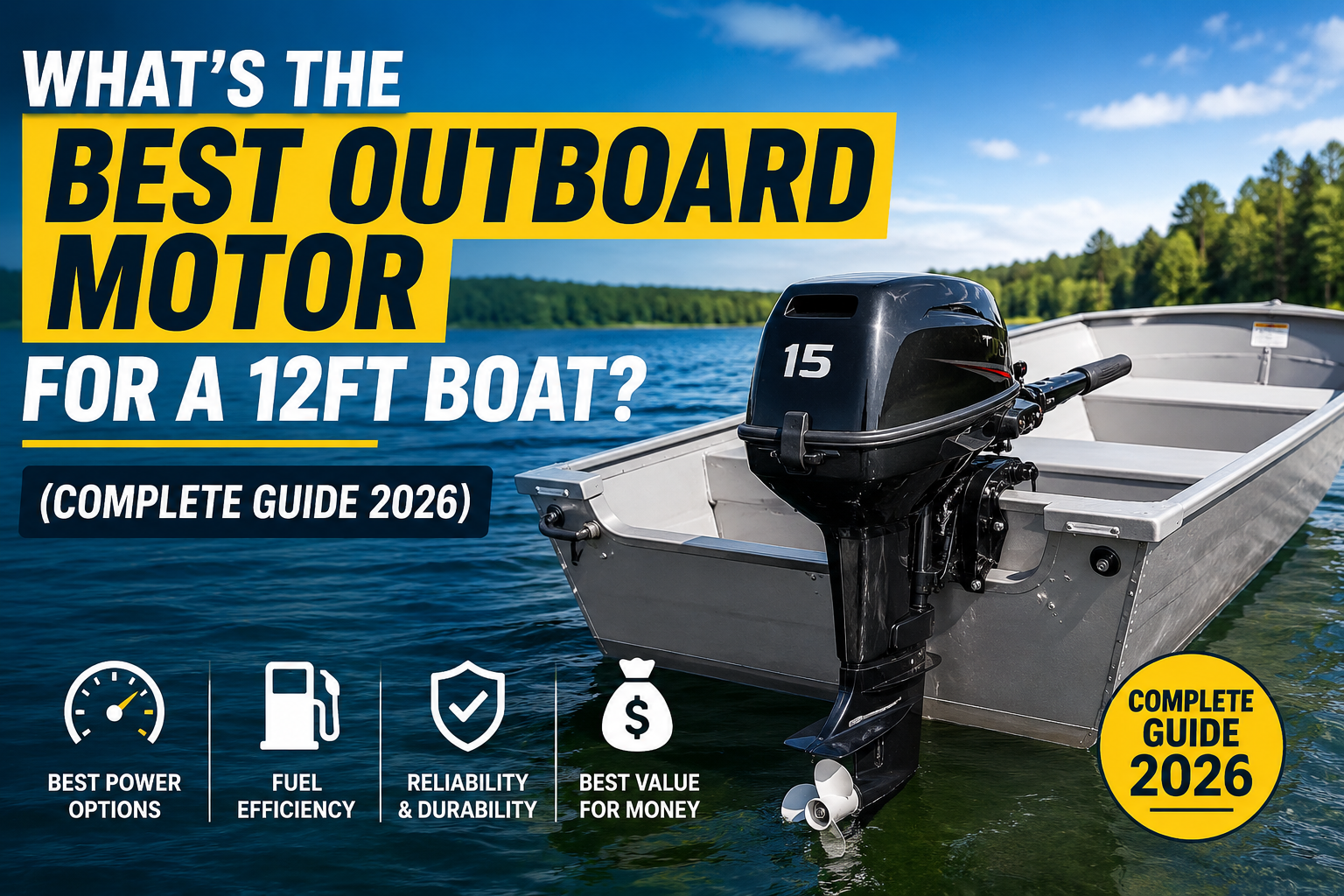
If you’re heading out for a morning of bass fishing on a calm lake, navigating a tidal river for crabs, or ferrying gear out to a larger vessel anchored offshore, choosing the right outboard motor for your 12ft boat is one of the most important decisions you’ll make as a boater.
Get it wrong, and you’ll either be struggling upstream with an underpowered motor or worse, dangerously overloading a small hull with too much horsepower.
In this guide, we’ll break down exactly what motor you need based on how and where you use your boat, what horsepower range is ideal, which fuel type makes the most sense, and what mistakes most buyers make.
Why Motor Choice Matters More on a 12ft Boat
A 12-foot aluminum or fiberglass boat typically weighs between 150 and 300 lbs (hull only). Add a motor, passengers, fuel, gear, and catch, and you’re quickly approaching the max capacity printed on that hull plate.
Small boats have zero margin for error. An oversized motor can make the boat plane dangerously, blow out the transom, or flip in a wake. An undersized motor leaves you stranded against a river current or unable to make it back to shore before a storm rolls in.
This is why matching the motor to the boat, and the activity, matters far more on a 12ft hull than on a 20ft offshore vessel.
What Horsepower Do You Need for a 12ft Boat?
Most 12ft aluminum jon boats and small fiberglass tenders are rated for 10–25 HP at the absolute maximum. The sweet spot for most uses is 9.9 to 15 HP.
Here’s a quick breakdown by use case:
| Use Case | Recommended HP | Why |
| Calm lake fishing | 5–9.9 HP | Low speed, light gear, quiet operation |
| River fishing / light current | 9.9–15 HP | Needs grunt to push upstream |
| Duck hunting (marsh/shallows) | 6–9.9 HP + tiller | Shallow draft, quiet, light weight |
| Crabbing (coastal bay) | 9.9–15 HP | Moderate load, some chop |
| Coastal/tidal use | 15–25 HP | Handles wind, current, loaded weight |
| Tender to larger vessel | 9.9–15 HP | Quick, reliable, portable |
Pro tip: Many boaters deliberately choose a 9.9 HP motor even when their hull is rated to 15 HP. Why? In many regions, a “9.9 HP or under” motor qualifies for no-license or reduced-registration rules, and they’re lighter, more fuel-efficient, and nearly as fast on a small hull.
The Best Outboard Motors for a 12ft Boat
1. Honda BF10 — Best Overall for Reliability
- HP: 10
- Weight: ~62 lbs
- Fuel: 4-stroke gasoline
- Best for: Lake fishing, river use, general purpose
Honda’s BF series is widely considered the gold standard in small outboard reliability. The BF10 starts easily, runs cleanly, and holds up for years with minimal maintenance. It’s the motor you can put in a shed over winter, pull out in spring, and trust it to start on the second pull.
The only downside: it’s not the lightest option in this class, and the price tag reflects the quality.
2. Yamaha F9.9 — Best for Versatility
- HP: 9.9
- Weight: ~57 lbs
- Fuel: 4-stroke gasoline
- Best for: Mixed use — lakes, rivers, tidal bays
Yamaha’s F9.9 is the go-to choice for boaters who want a single motor that performs well across multiple environments. It pushes a loaded 12ft boat confidently in choppy coastal conditions, yet sips fuel on calm lake mornings.
It’s also the most popular choice for serious anglers who need that 9.9 HP registration threshold without sacrificing performance.
3. Tohatsu MFS 9.9 — Best Value
- HP: 9.9
- Weight: ~55 lbs
- Fuel: 4-stroke gasoline
- Best for: Budget-conscious buyers, fishing, casual use
Tohatsu doesn’t get the same name recognition as Honda or Yamaha, but they’ve been building outboards since the 1950s. The MFS 9.9 is a genuinely excellent motor at a noticeably lower price point, with similar reliability and fuel efficiency to its more expensive competitors.
If you’re buying your first 12ft boat setup or want a backup motor, this is the best value on the market today.
4. Mercury F15 — Best for Coastal and Sea Use
- HP: 15
- Weight: ~88 lbs
- Fuel: 4-stroke gasoline
- Best for: Coastal, tidal, and open water use
When you’re taking a 12ft boat into open coastal water, tidal rivers with strong current, or choppy conditions, the extra horsepower of the Mercury F15 is worth the added weight. It gets you up on plane faster, handles loaded boats confidently, and gives you the reserve power to push through wind and chop.
This is the motor we’d recommend for anyone using their 12ft boat as a tender to reach a larger vessel in open anchorages.
5. Minn Kota Endura C2 55 lb Thrust — Best Electric for Fishing
- Thrust: 55 lbs
- Weight: ~17 lbs
- Power: 12V Electric (battery required)
- Best for: Calm lake fishing, duck hunting, crabbing in protected waters
If you’re fishing or hunting in calm, sheltered water and don’t need to travel far, an electric trolling motor changes everything. Zero noise, zero exhaust, infinitely variable speed — and you don’t need to carry fuel.
The Minn Kota Endura C2 at 55 lbs of thrust is plenty for a 12ft aluminum jon boat. Pair it with a deep-cycle marine battery and you’ve got several hours of quiet operation.
Important: Electric motors are not suitable for open coastal, sea, or strong-current conditions. They’re a second motor, not a sole solution, for anyone using their boat in varied environments.
6. Suzuki DF6A — Best for Duck Hunting and Marsh Use
- HP: 6
- Weight: ~47 lbs
- Fuel: 4-stroke gasoline
- Best for: Shallow water, marsh, duck hunting
When you’re pushing through skinny water with a loaded duck boat at 5am, weight and draft matter as much as horsepower. The Suzuki DF6A is light enough to tilt up quickly, quiet enough not to blow your blind, and powerful enough to move through marsh grass.
It’s not a motor for open water, but for what it does, it’s exceptional.
2-Stroke vs 4-Stroke: Which Is Right for a 12ft Boat?
This is one of the most common debates among small boat owners. Here’s the honest answer:
4-stroke wins for most people today.
Modern 4-stroke motors are quieter, cleaner, more fuel-efficient, and require less maintenance than 2-stroke equivalents. In most regions, older 2-stroke carbureted motors are also being phased out due to emissions regulations.
When a 2-stroke still makes sense:
- You need the absolute lightest motor possible (2-strokes can be significantly lighter)
- You’re in a remote area where oil-injection reliability matters less than simplicity
- You already own a well-maintained 2-stroke and don’t need to replace it
For a new purchase in 2026, we’d recommend a 4-stroke in almost every scenario.
Electric vs Gas: A Real-World Comparison
| Factor | Electric | Gas |
| Noise | Silent | Moderate to loud |
| Maintenance | Very low | Regular servicing needed |
| Range | Limited by battery | Much longer range |
| Upfront cost | Lower | Higher |
| Open water use | Not suitable | Suitable |
| Regulations | Often no license needed | May require registration |
Common Mistakes When Choosing an Outboard for a 12ft Boat
Mistake 1: Ignoring the Transom Rating
Every boat has a maximum HP rating stamped on its capacity plate. Never exceed it. A 15 HP motor on a transom rated for 10 HP is a serious safety risk, not just an efficiency issue.
Mistake 2: Buying Too Much Motor
More horsepower sounds better. In reality, a 25 HP motor on a 12ft jon boat is dangerous, illegal in many cases, and wastes money. Bigger motors are also heavier, which affects balance, trailer setup, and portability.
Mistake 3: Underestimating Total Weight
When calculating if a motor is right for your boat, don’t just think about the motor. Add up: motor weight + your weight + passenger weight + fuel + gear + catch. Most 12ft boats have a total capacity of 500–700 lbs. It fills up faster than you think.
Mistake 4: Choosing Gas When Electric Is Better (or Vice Versa)
If 90% of your use is calm lake fishing within a mile of the launch, a gas motor is overkill. If 10% of your use involves coastal conditions, an electric-only setup will strand you.
Mistake 5: Skipping the Short Shaft vs Long Shaft Check
12ft boats typically need a short shaft motor (15″), but this varies. Measure your transom height before buying, a motor that sits too deep or too shallow will cavitate or blow air, destroying efficiency and potentially damaging the motor.
Lake vs River vs Coastal vs Sea: Does the Water Type Change Your Motor?
Yes — significantly.
- Lakes: Calm, predictable. Lighter motors (5–9.9 HP) are perfectly suitable. Noise and emissions matter for environmental reasons.
- Rivers: Current matters. You need enough power to push upstream when loaded. 9.9–15 HP. Rocks and shallow sections mean you’ll tilt the motor up frequently — lighter is better.
- Coastal/tidal bays: Chop, wind, current, and longer distances. 15 HP minimum is advisable. Salt water means you absolutely must flush the motor with fresh water after every use.
- Open sea/offshore: A 12ft boat has no business being in true open sea conditions, regardless of motor size. But for short coastal crossings, protected anchorages, and harbor tenders: 15–25 HP, quality fuel system, and always a kill-switch lanyard.
Quick Decision Guide: Which Motor Should You Choose?
Calm lake fishing only → Honda BF5 or Minn Kota Electric Mixed lake/river use → Yamaha F9.9 or Tohatsu MFS 9.9 Duck hunting / marsh → Suzuki DF6A Crabbing in a bay → Yamaha F9.9 or Mercury F9.9 Coastal and sea use → Mercury F15 Tender to a larger vessel → Yamaha F9.9 or Mercury F15 Budget pick for any use → Tohatsu MFS 9.9
Final Verdict
There’s no single “best” outboard motor for a 12ft boat — it depends entirely on where you boat and what you do. But if we had to pick one motor that handles the widest range of conditions well, the Yamaha F9.9 is our top overall recommendation for most 12ft boat owners.
It’s reliable, fuel-efficient, hits the 9.9 HP registration sweet spot in most regions, handles salt and fresh water equally well, and has a huge service network worldwide.
For budget buyers, the Tohatsu MFS 9.9 delivers nearly identical performance at a lower price. For coastal and sea use, step up to the Mercury F15 without hesitation.
Whatever motor you choose, respect your hull’s capacity rating, maintain it properly, and match it to the water you’re actually on. That’s the real secret to getting it right.