
How to Choose Between MIG, TIG, and Stick Welders: Complete Buying Guide (2026)

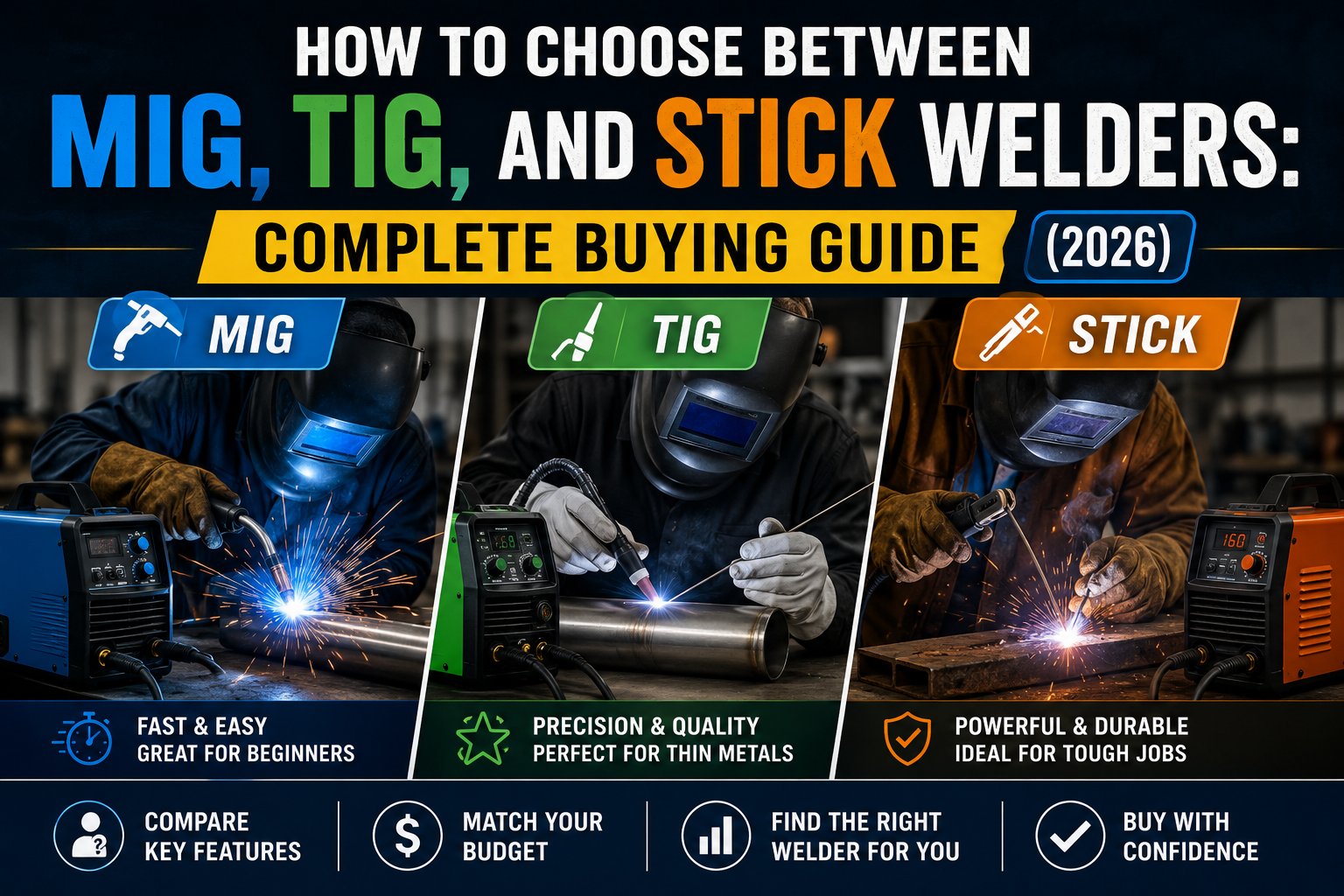
If you’ve ever stood in front of a welding machine catalogue and wondered, MIG, TIG, or Stick, what on earth is the difference?. You’re not alone. It’s one of the most common questions we get from customers, whether they’re complete beginners or experienced tradespeople looking to upgrade their setup.
The truth is, there’s no single “best” welder. Each process has its strengths, and the right choice depends on what you’re welding, where you’re working, and how much experience you have. In this guide, we break down all three welding processes in plain English, so you can make the right call before spending your money.
What Is MIG Welding?
MIG stands for Metal Inert Gas, technically known as Gas Metal Arc Welding (GMAW). A continuously fed wire electrode passes through a welding gun, and an electric arc melts that wire directly into the joint. At the same time, a shielding gas (usually a 75% argon / 25% CO2 mix) flows through the nozzle to protect the weld pool from contamination.
Think of MIG welding as the automatic gearbox of the welding world; it does a lot of the work for you.
MIG Welding: Pros and Cons
Pros:
- Easiest process to learn, most beginners can lay a decent bead within a few hours
- Fast welding speed, ideal for production work
- Clean results with minimal spatter and slag
- Works well on steel, stainless steel, and aluminium
- Great for thin to medium thickness metals
Cons:
- Requires shielding gas (extra running cost)
- Not suitable for outdoor/windy conditions unless using flux-core wire
- Equipment setup is slightly more involved (voltage, wire speed, gas)
- Less portable than stick welding
Who Should Choose MIG?
MIG welding is the best starting point for most beginners and hobbyists. It’s also the go-to process for automotive bodywork, home fabrication, light structural work, and manufacturing environments. If you want to get welding quickly with professional-looking results, MIG is your answer.
What Is TIG Welding?
TIG stands for Tungsten Inert Gas, technically Gas Tungsten Arc Welding (GTAW). Unlike MIG, the tungsten electrode doesn’t melt into the weld. Instead, you hold the torch in one hand and feed a separate filler rod into the weld pool with the other. A foot pedal controls amperage in real time, giving you extraordinary precision.
TIG is the manual gearbox of welding, total control, but it demands a lot from the operator.
TIG Welding: Pros and Cons
Pros:
- Produces the highest quality, most visually clean welds of all three processes
- Precise control over heat input, perfect for thin or delicate materials
- Works on a wide range of metals, including aluminum, stainless steel, titanium, and copper
- No spatter, minimal post-weld cleanup required
- Industry standard for aerospace, food-grade fabrication, and pipe welding
Cons:
- The hardest process to learn is expected to take 40–80 hours of practice before consistent results
- Slowest welding speed of the three processes
- Most expensive equipment and consumables
- Requires both hands plus a foot pedal simultaneously
Who Should Choose TIG?
TIG welding is for experienced welders or those willing to invest serious time in learning. If you need precise, beautiful welds on stainless steel, aluminum, or exotic metals, for example, exhaust systems, roll cages, marine fittings, or artistic metalwork, TIG is worth the learning curve.
What Is Stick Welding?
Stick welding, formerly known as Shielded Metal Arc Welding (SMAW), is the oldest and simplest arc welding process. A consumable flux-coated electrode (the “stick”) creates an arc with the workpiece, and the flux coating burns off, producing its own shielding gas. No external gas bottle required. Stick welding is the Land Rover Defender of welding, built tough, works anywhere, no fuss.
Stick Welding: Pros and Cons
Pros:
- Works outdoors in wind, rain, and dusty conditions
- No shielding gas needed, lower running costs
- Works on rusty, painted, or dirty metal
- Highly portable, minimal equipment to carry
- Excellent penetration on thicker metals
- Most affordable equipment to buy
Cons:
- Produces more spatter and slag than MIG or TIG
- Requires slag chipping after every weld pass
- Shorter electrodes mean frequent stops to change rods
- Not ideal for thin sheet metal
- Steeper learning curve than MIG for achieving consistent quality
Who Should Choose Stick?
Stick welding is ideal for outdoor work, farm and agricultural repairs, heavy structural fabrication, pipeline work, and any situation where portability matters. It’s also a great second process for those who already know MIG and want more versatility.
MIG vs TIG vs Stick: Side-by-Side Comparison
| Feature | MIG | TIG | Stick |
| Ease of learning | Easy | Hard | Moderate |
| Weld quality | Good | Excellent | Good |
| Weld speed | Fast | Slow | Moderate |
| Indoor use | Yes | Yes | Yes |
| Outdoor use | Limited | Limited | Excellent |
| Thin metals | Good | Excellent | Difficult |
| Thick metals | Good | Good | Excellent |
| Equipment cost | Medium | High | Low |
| Running costs | Medium | High | Low |
| Portability | Medium | Low | High |
| Best for | Beginners, production | Precision work | Outdoor, structural |
Which Welder Is Right for Your Situation?
Still not sure? Use this quick guide:
Choose MIG if:
- You’re a beginner just starting out
- You work mainly indoors in a workshop
- You weld mild steel, stainless, or aluminum
- You want fast, clean results without a long learning curve
- You do automotive, fabrication, or home DIY projects
Key points TIG
- You already have welding experience
- You need the highest possible weld quality
- You work with thin, exotic, or speciality metals
- Your projects include aerospace, food equipment, or marine stainless work
- You’re willing to invest time in developing advanced skills
Choose Stick if:
- You work outdoors or on construction and farm sites
- You weld thick, heavy structural steel
- Portability is important to you
- You need to weld on rusty or painted surfaces
- You want the lowest equipment and running costs
Do You Need All Three?
Many professional welders use all three processes depending on the job. If you want maximum flexibility, modern multi-process welders can handle MIG, TIG, and Stick from a single machine, excellent value if you want to grow your skills over time without buying multiple units.
Browse Our Welding Equipment
At Outboard Motors Shop, we stock a full range of professional welding machines, including MIG welders, TIG welders, and Stick welders, suitable for both hobbyists and trade professionals. Whether you’re working in a garage at home or on a commercial job site, we have a machine to match your needs and budget.
Not sure which one is right for your project? Contact our team, we’re happy to help you choose.
Frequently Asked Questions
Q: Which welder is best for a complete beginner?
MIG welding is the best starting point for beginners. The wire feeds automatically and the learning curve is much shorter than TIG or Stick. Most people can produce decent welds within their first few hours of practice.
Q: Can I use a MIG welder outdoors?
Standard MIG welding is not ideal outdoors because wind can blow away the shielding gas, causing weld defects. However, using flux-core wire instead of solid wire solves this problem, flux-core creates its own shielding as it burns.
Q: Is TIG welding only for professionals?
Not at all, but TIG does require patience and practice. If you’re committed to learning, TIG welding is achievable for enthusiastic hobbyists. It just takes significantly more practice than MIG or Stick.
Q: What is the cheapest type of welder to run?
Stick welding has the lowest running costs because it doesn’t require shielding gas. Electrodes are inexpensive and widely available. The trade-off is more slag cleanup and a rougher weld appearance compared to MIG or TIG.
Q: Can one machine do MIG, TIG, and Stick? Yes! Multi-process welders are available that support all three welding processes from a single unit. These are a great choice if you want flexibility without buying three separate machines.