
Yamaha Outboard Motor Review 2026: Full Range Breakdown

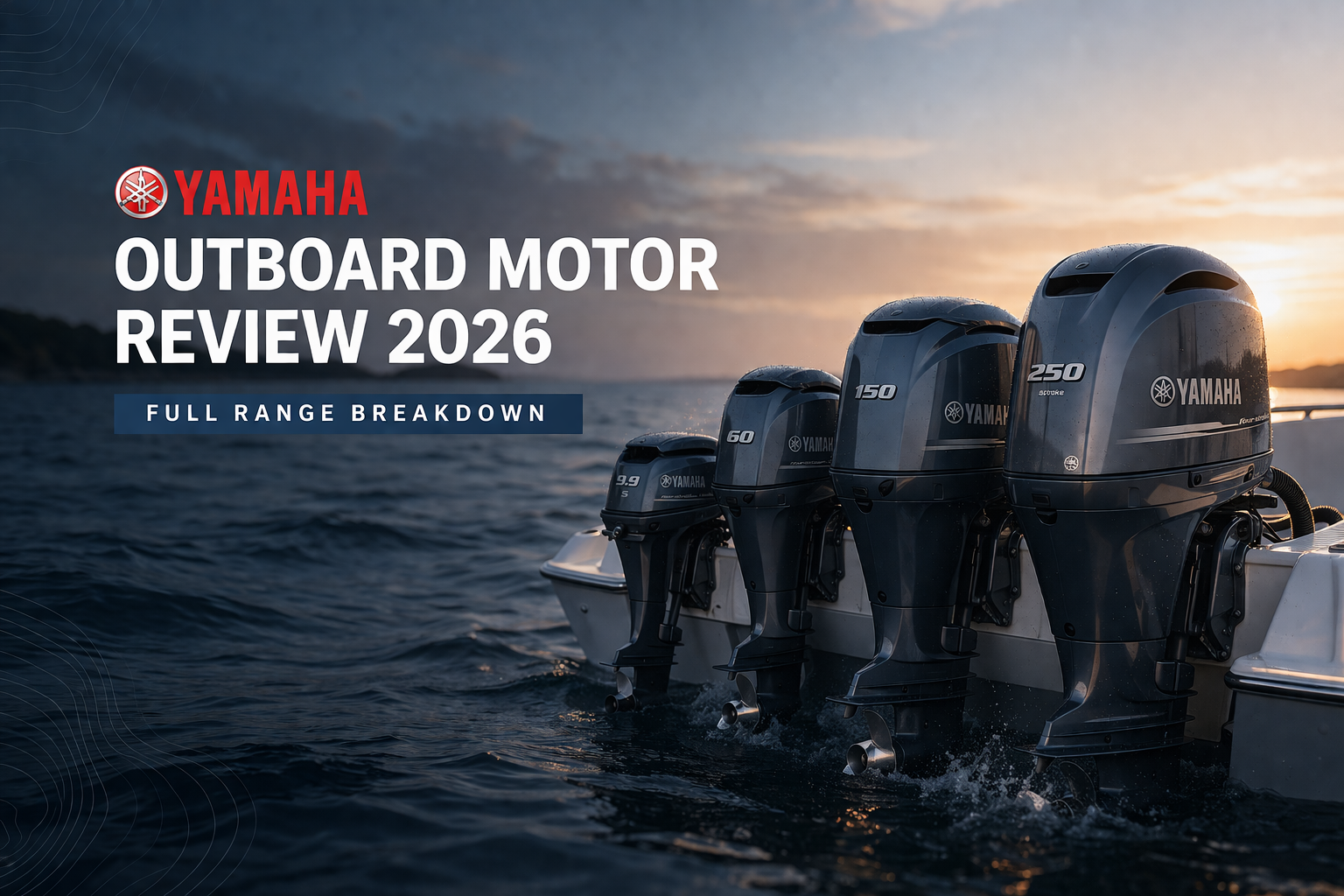
If you’re fishing shallow flats, crossing open ocean, or just cruising a quiet lake on a weekend, there’s a Yamaha outboard built for exactly that moment. The 2026 lineup is the most complete Yamaha has ever offered, stretching from a featherlight 2.5 HP portable all the way to the awe-inspiring 450 HP V8 XTO Offshore. This guide breaks down every major category, who each engine is built for, and what makes Yamaha worth your serious consideration in 2026.
Why Yamaha Still Leads the Market in 2026
Yamaha entered the 4-stroke outboard market in the early 2000s and quickly earned a reputation as the reliable workhorse that replaced smoky, high-maintenance 2-strokes. Two decades later, that reputation hasn’t just held, it has deepened. Yamaha outboards are known for powerful, torque-rich engines with strong mid-range acceleration, an extensive dealer network, and proven offshore reliability.
In 2026, Yamaha backs that reputation with meaningful engineering across every segment: refined fuel injection systems, digital integration throughout outboardmotorsshop, and industry-first technologies like direct injection and integrated electric steering on flagship models.
If reliability, resale value, and long-term support matter to you, and they should, Yamaha belongs at the top of your shortlist.
Yamaha 2026 Outboard Lineup at a Glance
| Category | Models | Best For |
| Ultra-Portable | F2.5, F4, F6 | Tenders, inflatables, small craft |
| Portable Mid-Range | F15, F20, F25 | Aluminum fishing boats, jons, tenders |
| Mid-Power | F40–F90 | Bass boats, pontoons, bay boats |
| High-Performance | F115–F300 | Center consoles, offshore, multi-engine |
| Offshore Powerhouses | F350 V6, XTO F425/F450 V8 | Large sportfish, heavy offshore rigs |
Section 1: Ultra-Portable Series (2.5 HP – 6 HP)
Yamaha F2.5 — The Pocket-Sized Workhorse
The F2.5 is the smallest engine in Yamaha’s entire lineup, but calling it a throwaway motor would be a mistake. Completely redesigned for 2026, it is cleaner, more portable, and provides smooth, efficient operation for small crafts, inflatables, and tenders. It features forward, neutral, and reverse shifting with 360° swivel steering, three-way storage positions (starboard, front, and port) without oil leakage, and a large ergonomic tiller handle for comfortable single-hand operation.
For sailors needing a reliable dinghy tender engine, kayak anglers with a small flat-bottom skiff, or coastal resort operators running passenger tenders, the F2.5 simply works.
Highlights:
- Lightest outboard in the Yamaha range
- 360° swivel steering for tight maneuvering
- Three-position storage with no oil leakage risk
- Completely redesigned for 2026
Yamaha F6 — Compact Power with Extended Range
The F6 is a compact and impressive 4-stroke portable outboard that delivers smooth, quiet, and efficient performance. At just 59 lbs. (15″ shaft, dry weight), it punches well above its size class. A notable feature is its built-in fuel tank combined with external tank compatibility, giving you short-range convenience without sacrificing extended-range flexibility. The labyrinth exhaust and long-span mounting system keep operation whisper-quiet.
The F6 fits perfectly on inflatables, small aluminum boats, and sailing tenders where low weight is essential yet reliable power is still needed.
Highlights:
- 59 lbs dry weight (15″ shaft)
- Built-in fuel tank + external tank compatibility
- Labyrinth exhaust for smooth, quiet power
- Tiller handle with ergonomic twist-grip throttle
Section 2: Portable Mid-Range Series (15 HP – 25 HP)
This is where Yamaha’s award-winning portable platform really shines. The F15, F20, and F25 share a proven single-overhead-camshaft (SOHC) in-line design, and all three feature a two-valve-per-cylinder layout that provides better breathing and more power for their respective displacement classes.
Yamaha F15 — The Fuel-Efficiency Champion
The F15’s 362cc, twin-cylinder SOHC engine with a single carburetor and CDI Microcomputer Ignition System makes it one of the most fuel-efficient outboards in its class. Weighing just 111 lbs, it handles lightweight craft, including aluminum fishing boats, tenders, and inflatables, with easy confidence. It’s a favourite among duck hunters and freshwater anglers who need reliable, quiet power without burning through fuel all day.
Yamaha F20 — Largest Displacement in Class
The F20 builds on the same award-winning platform as the F25. Its twin-cylinder SOHC design and streamlined intake manifold deliver solid mid-range power, and at just 126 lbs, it remains one of the most manageable engines in this category. Available with EFI for smoother power delivery, front-mounted controls for smooth shifting and single-action steering friction adjustment, and Yamaha’s YDC-30 aluminum alloy construction for superior corrosion resistance.
For boaters who frequently load and unload at the ramp, the ergonomic carrying handle and brims make a real difference at the end of a long day on the water.
Yamaha F25 — The Class Leader in Power-to-Weight
The F25 is still the lightest 25-horsepower outboard on the water, two-stroke or four-stroke. Its 432cc engine with battery-less EFI is a significant achievement: you get the fuel efficiency and responsiveness of electronic fuel injection without the dependence on a boat battery for starting. New for 2026, the F25 is available in pearlescent white and matte brown (in addition to Yamaha gray), the latter being a popular option for waterfowl hunters who need a stealthy profile on the marsh.
The F25’s Microcomputer Ignition automatically adjusts timing to maintain maximum engine performance, economy, and power under all conditions, a feature that makes a measurable difference over a long day of varied throttle use.
Who it’s for: Jon boats, 14-foot aluminum fishing boats, small inflatables, duck hunters, and anglers who trail and launch frequently.
Highlights:
- Lightest 25 HP outboard on the market
- Battery-less EFI (pull-start models included)
- Available in matte brown for stealth hunting applications
- Automatic decompression for easier manual starting
- Siren 3 Boat Monitoring is now compatible with all portable models
Section 3: Mid-Power Series (40 HP – 115 HP)
This is the broadest and most versatile segment of the Yamaha lineup. These engines power everything from bay fishing boats and pontoons to family runabouts and light offshore duty. The 2026 models in this range feature refined EFI, improved alternator output for electronics-heavy setups, and Yamaha’s signature corrosion-resistant construction for saltwater durability.
The V MAX SHO In-Line Series (VF90 / VF115)
For anglers and performance-oriented boaters, the V MAX SHO (Super High Output) in-line series offers impressive power from a compact package. The VF90 starts at $12,545 and the VF115 at $14,060, competitive pricing for the level of performance they deliver.
The SHO’s Variable Camshaft Timing (VCT) adjusts the intake camshaft timing based on load and RPM, producing broad power across the entire rev range rather than peaking only at wide-open throttle. This translates to noticeably better hole-shot performance and stronger midrange pull, exactly what bass tournament anglers and bay boat owners demand.
Highlights:
- Variable Camshaft Timing for a broad power curve
- Compact, lightweight design
- Strong hole-shot performance
- Available in multiple shaft lengths
Section 4: High-Performance Series (150 HP – 300 HP)
Yamaha’s F150 through F300 range covers the heart of the offshore and serious inshore market. These are the engines you’ll find powering twin- and triple-engine center consoles, walkaround fishing boats, and offshore express cruisers.
F300 — The Proven Offshore Workhorse
The F300 has long been one of Yamaha’s most trusted offshore engines. Its 4.2L V6 platform delivers reliable high-RPM power with excellent fuel economy at cruise. Available in multiple shaft lengths and compatible with Yamaha’s outboard motor shop digital control system, the F300 is a natural fit for twin-engine offshore setups where consistent, predictable power is non-negotiable.
Yamaha outboards are well known for excellent torque curves that make them particularly effective for heavier hulls or boats carrying multiple passengers and gear, a characteristic that’s most apparent in the F150–F300 range.
Section 5: The Offshore Powerhouses, F350 and XTO
This is where Yamaha’s engineering ambition is most visible in 2026.
Yamaha F350, The V6 That Changed Everything
The all-new F350 is built on a 4.3L V6 block and represents a fundamental rethink of what a 350 HP outboard should be. The previous F350 was a 5.3L V8; by moving to the V6 platform, Yamaha created an engine that is over 40 kg lighter while delivering better power-to-weight performance. This is not a trivial upgrade on a twin-engine setup; that’s 80+ kg removed from the transom.
The 4.3L V6 Offshore F350 merges the best technology from across Yamaha’s full lineup, producing jaw-dropping power with the best power-to-weight ratio in its class, by more than 65 pounds over comparable competitors.
Key engineering highlights of the F350:
- 11:1 compression ratio on a 4.3L displacement, achievable through the longer stroke and 40% larger surge tanks in the intake manifold
- 81mm electronic throttle valve borrowed directly from the flagship XTO 450
- 74-amp alternator producing more than 30 net amps at idle, nearly double comparable Yamaha outboards
- Integrated Digital Electric Steering, no hydraulic pumps, hoses, or bleeding procedures required
- Thrust Enhancing Reverse Exhaust (TERE) keeps exhaust bubbles above the anti-ventilation plate below 2,500 RPM, so the prop bites only clean water in reverse
- TotalTilt®, double-tap the trim button to automatically tilt the engine to full height, with an integrated tilt limiter to prevent transom contact
- Runs on standard 89-octane fuel despite its high-compression, high-performance specifications
The F350 is available in Yamaha gray, pearlescent white, and new classic white. It comes in 25″, 30″, and 35″ shaft lengths, and is fully compatible with outboardmotorsshop for multi-engine joystick control.
Best for: Large offshore center consoles, high-performance RIBs, serious fishing rigs demanding twin-engine reliability without the weight penalty of a V8 platform.
Yamaha XTO Offshore F425 and F450
If the F350 is remarkable, the XTO Offshore is extraordinary. Built around a 5.6L (5,559cc) 60° V8 DOHC engine with 32 valves, the XTO F450 and F425. Its represent the most technologically advanced outboards Yamaha has ever produced, and they carry multiple industry firsts.
The XTO was the first four-stroke outboard in the industry to use direct injection. A five-pump fuel delivery system creating up to 2,900 PSI of fuel injection pressure for maximum atomization and efficiency. The 12.3:1 compression ratio (F450) delivers outstanding fuel economy and power simultaneously.
Industry firsts and standout technologies:
- First direct injection 4-stroke outboard in the industry
- Integrated electric steering directs digital signals from the helm to the steering control unit, with a backup manual system for safety
- Phase Angle Control Charging up to 96 amps of net charging power at idle per engine (up to 480 amps in a five-engine configuration)
- Iridium spark plugs for improved throttle response, economy, and extended service life
- Quad thermostats (two per cylinder bank) to independently regulate engine and oil temperature
- Thrust Enhancing Reverse Exhaust up to 300% more reverse thrust than the previous F350
- TotalTilt® with 73-degree tilt range the entire motor and lower unit can be raised completely clear of the water
- Gearcase lubricant exchange without removing the boat from the water
The XTO propellers are purpose-built for this engine alone, ranging from 16 to 17⅛ inches in diameter with increased blade surface area, specifically calibrated to complement the XTO’s massive torque potential. Yamaha also offers XTO EC propellers designed to address propeller ventilation that can occur at the extreme power levels these engines produce.
The XTO is available in 25″, 30″, and 35″ shaft lengths, and comes in Yamaha gray, pearlescent white, or unpainted for custom boat builder color-matching.
Best for: Large sportfishing convertibles, heavy offshore express yachts, high-performance multi-engine center consoles where maximum power, advanced digital integration, and absolute reliability are required.
Section 6: Specialty — Yamaha Jet Drive (F90JB)
For boaters operating in extremely shallow water, rivers, rocky shoals, and recreational parks, Yamaha’s F90JB jet drive outboard is a unique solution. At $13,050, this 90 HP four-stroke jet drive replaces the traditional propeller with a water-jet propulsion system, eliminating the risk of prop damage in skinny water. It’s particularly popular among river guides, white-water-adjacent boaters, and recreational users in areas where prop strikes would be a constant concern.
Yamaha vs. The Competition in 2026
Yamaha consistently outperforms rivals on a few key dimensions:
Autopilot and joystick docking: outboardmotorsshop gives Yamaha a clear edge over most competitors for integrated boat control. If precision docking, automated fishing modes, and multi-engine joystick maneuverability matter to you, Yamaha has the most mature ecosystem.
Torque and load performance: Yamaha’s torque curves make its engines particularly effective for heavier hulls or boats carrying multiple passengers and gear, a key advantage for offshore and bluewater applications.
Dealer network and service: Yamaha’s extensive dealer presence means parts availability and qualified service are rarely a concern, even in less populated coastal markets.
Reliability reputation: Yamaha F-series engines are widely regarded as proven workhorses. Their long-term track record across commercial, recreational, and offshore applications gives buyers confidence that is difficult to quantify but easy to feel when you’re 30 miles offshore.
Yamaha Outboard Buying Guide: Which Engine Is Right for You?
Small boats, tenders, and inflatables (under 14 ft): → F2.5, F4, or F6. Keep it light, keep it simple.
Aluminum fishing boats, jon boats, tenders (14–17 ft): → F15, F20, or F25. The F25 is the premium choice if budget allows.
Bass boats, pontoons, and bay boats: → F40 through F115, with the V MAX SHO series for performance-oriented anglers.
Center consoles, offshore, and multi-engine setups (single 150–300 HP): → F150 through F300. The F300 is the workhorse standard.
Large offshore boats, heavy twin or triple configurations: → F350 V6 for the best power-to-weight. XTO F425/F450 for maximum power and technology.
Shallow-water, river, or jet-required applications: → F90JB Jet Drive.
Final Verdict: Is a 2026 Yamaha Outboard Worth It?
Yes, emphatically, for most buyers.
Yamaha’s 2026 lineup doesn’t have a weak link. From the elegantly simple F2.5 to the technologically extraordinary XTO F450, every engine in this range reflects decades of refinement, real-world testing, and genuine engineering investment. The brand’s long-term reliability track record, broad service network, and industry-leading digital integration through outboardmotorsshop make Yamaha the safest bet across virtually every boating application.
The F25 is still the best portable outboard on the market. The new F350 is a landmark engineering achievement. And the XTO Offshore remains, by nearly every objective measure, the most sophisticated production outboard engine in existence. If you’re in the market for a new outboard in 2026, start with Yamaha. You’ll likely end with Yamaha too.