
2-Stroke vs 4-Stroke Outboard Motor: Which Is Better for You?

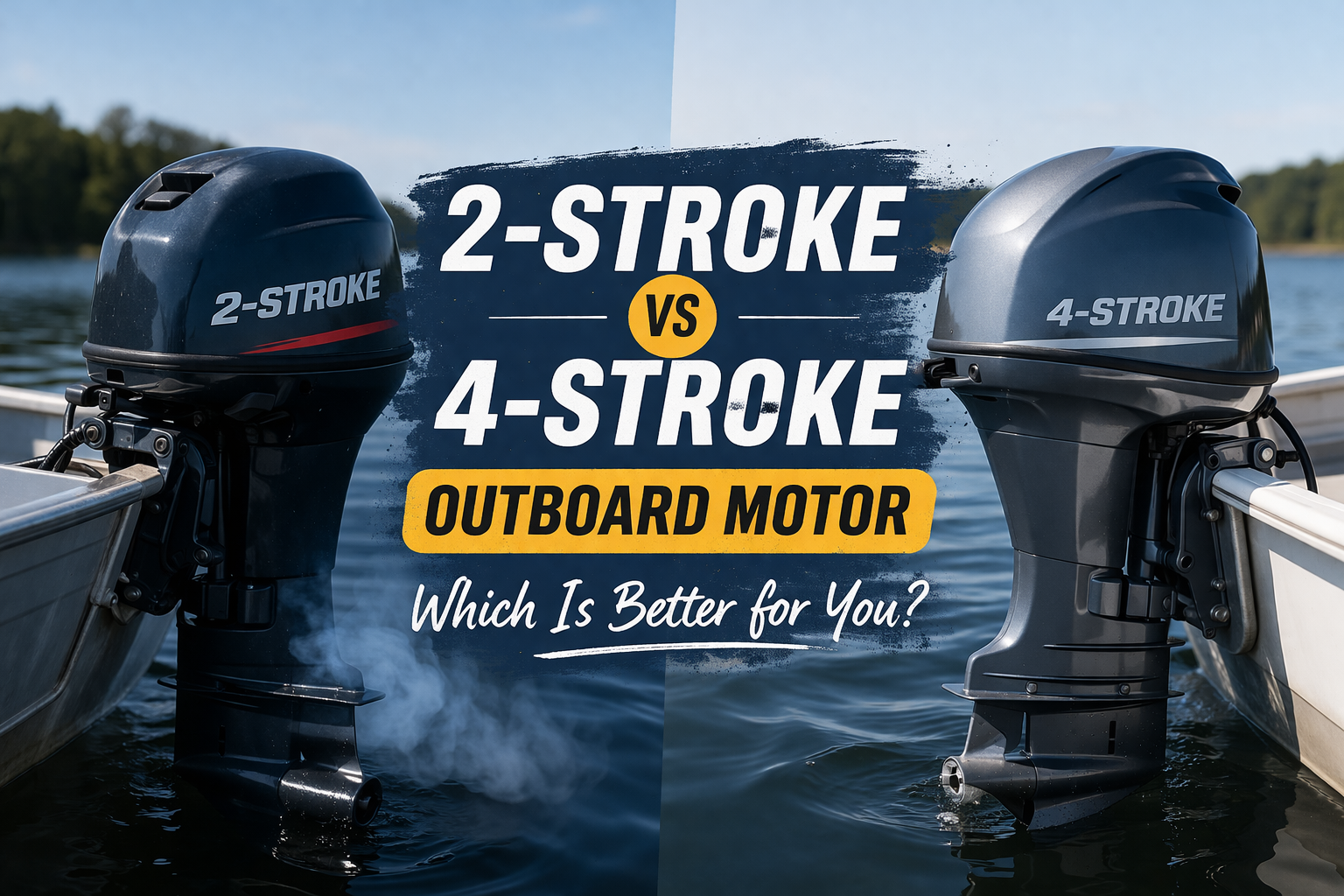
Choosing between a 2-stroke vs 4-stroke outboard motor is one of the most important decisions any boater will make. The engine you pick affects everything, from how fast you can accelerate across the water to how much you spend at the fuel dock, how often you’re in the repair shop, and whether you’re even allowed in certain environmentally protected waters.
The debate has evolved significantly in recent years. Technological advances have blurred many of the traditional differences, making the choice more nuanced than ever. In this guide, we break down every major factor, performance, fuel economy, maintenance, cost, emissions, and more so you can pick the right outboard motor with confidence.
How Do 2-Stroke and 4-Stroke Outboard Engines Work?
Understanding the basic mechanics helps you appreciate why each engine performs the way it does.
What Is a 2-Stroke Outboard Motor?
A 2-stroke outboard motor completes one full power cycle in just two piston strokes, one up and one down, within a single crankshaft revolution. Because combustion happens every revolution, 2-stroke engines generate power more frequently, delivering a higher power-to-weight ratio.
Traditional 2-stroke engines mix oil directly into the fuel for lubrication. Modern versions, however, use direct fuel injection (DFI) and electronic oil mixing, which has dramatically improved their fuel economy and reduced emissions.
What Is a 4-Stroke Outboard Motor?
A 4-stroke outboard motor completes its power cycle over four piston strokes: intake, compression, power, and exhaust. Because the fuel burns more completely, 4-stroke engines are inherently more fuel-efficient and produce fewer emissions. They use a separate oil reservoir for lubrication, just like a car engine.
The more complex valve train in a 4-stroke engine makes it heavier and more expensive to build, but it also contributes to smoother, quieter operation and greater long-term durability.
2-Stroke vs 4-Stroke Outboard Motor: Head-to-Head Comparison
1. Power and Performance
2-Stroke: Thanks to firing every revolution, 2-stroke outboards deliver exceptional acceleration and top-end speed. This quick “hole-shot” performance the ability to get a boat up on plane fast makes them favorites for water sports, racing, and smaller, lighter boats.
4-Stroke: While historically seen as less sporty, modern 4-stroke outboards have closed the gap significantly. They produce excellent low-end torque, making them well-suited for heavier boats and steady cruising at sustained speeds.
Verdict: For raw acceleration and lightweight performance, 2-strokes still edge ahead. For torque and steady cruising power, 4-strokes are the stronger choice.
2. Fuel Efficiency
2-Stroke: Older 2-stroke engines had notoriously poor fuel economy because unburned fuel would escape with the exhaust. Modern direct-injection 2-strokes have largely resolved this, approaching 4-stroke efficiency in many conditions.
4-Stroke: 4-stroke outboards are widely recognized as leaders in fuel efficiency. Typical 4-stroke engines consume 20-30% less fuel than older 2-stroke models, making them the smarter choice for long-distance cruising and commercial use.
Verdict: 4-strokes win on fuel economy. Modern DFI 2-strokes narrow the gap considerably.
3. Weight and Portability
2-Stroke: With fewer internal components and no separate oil system, 2-stroke outboards are significantly lighter than equivalent 4-stroke models, ideal for small boats, jon boats, skiffs, and situations where portability is essential.
4-Stroke: The additional valve train, oil sump, and mechanical complexity make 4-stroke engines heavier. A 4-stroke engine of equal horsepower may be 20-40% heavier than its 2-stroke counterpart, which can affect boat performance and handling.
Verdict: 2-strokes are the clear winner for lightweight applications and portable setups.
4. Emissions and Environmental Impact
2-Stroke (older): Traditional 2-stroke engines emit significantly more hydrocarbons because some unburned fuel exits with the exhaust. This is why many lakes, rivers, and protected waterways have banned or restricted older 2-stroke outboards.
2-Stroke (modern DFI): Advanced direct-injection 2-strokes have dramatically cut emissions, meeting or exceeding EPA standards in many cases.
4-Stroke: 4-stroke outboards produce up to 90% fewer harmful emissions than older 2-stroke models. Their separate lubrication system means no raw oil is burned with the fuel, making them far cleaner and welcome in more waterways.
Verdict: 4-strokes are the environmentally superior choice. If you boat in regulated waters, a 4-stroke may not just be preferred it may be required.
5. Maintenance Requirements
2-Stroke: The simpler mechanical design means fewer things to go wrong. 2-stroke engines require less routine maintenance, no oil changes, no valve adjustments. However, they do require regular attention to the fuel/oil mix ratio.
4-Stroke: 4-stroke engines require regular oil changes, filter replacements, and annual servicing. This adds to ownership cost, but it also reflects a design built for long-term durability at lower RPM levels.
Verdict: 2-strokes are simpler day-to-day. 4-strokes demand more routine servicing but reward you with greater longevity.
6. Durability and Lifespan
2-Stroke: Because they fire with every revolution, 2-stroke engines run at higher RPMs, which creates more internal wear over time. They tend to have a shorter operational lifespan compared to 4-strokes under similar conditions.
4-Stroke: Designed to run at lower RPMs with a complete combustion cycle, 4-stroke outboards are more durable over the long haul. With proper maintenance, a quality 4-stroke outboard can outlast a 2-stroke by a significant margin.
Verdict: 4-strokes win on long-term durability and lifespan.
7. Noise and Vibration
2-Stroke: 2-stroke engines are traditionally louder and produce more vibration, though modern models have improved noticeably.
4-Stroke: 4-strokes run noticeably quieter and smoother a meaningful advantage on fishing trips where noise can spook fish, or on family outings where conversation at speed is important.
Verdict: 4-strokes are quieter and smoother a clear win for comfort-focused boaters.
8. Cost — Upfront vs. Long-Term
Upfront Cost: 2-stroke outboards are generally less expensive to purchase. A 2-stroke 50hp Yamaha typically retails around $6,500, while the same horsepower in a 4-stroke version can cost closer to $8,000 or more.
Long-Term Cost: The initial savings of a 2-stroke can be offset by higher fuel consumption and potentially more frequent repairs. 4-strokes cost more upfront but often provide better total cost of ownership through fuel savings and durability.
Verdict: 2-strokes win on purchase price. 4-strokes often win on total cost of ownership over several years.
Quick Comparison Table
| Feature | 2-Stroke Outboard | 4-Stroke Outboard |
| Power Cycle | 2 piston strokes | 4 piston strokes |
| Acceleration | Excellent | Good |
| Fuel Efficiency | Moderate (modern DFI: better) | Excellent |
| Weight | Lighter | Heavier |
| Emissions | Higher (older); Low (modern DFI) | Very Low |
| Maintenance | Simpler | More involved |
| Durability | Moderate | High |
| Noise Level | Louder | Quieter |
| Upfront Cost | Lower | Higher |
| Best For | Speed, portability, small boats | Cruising, fishing, large boats |
Who Should Choose a 2-Stroke Outboard Motor?
A 2-stroke outboard motor is the right choice for you if:
•You need a lightweight, portable engine for a small boat, jon boat, canoe, or skiff
• You prioritize quick acceleration for water sports, wakeboarding, or racing
•You boat in remote locations where complex maintenance isn’t practical
•You’re on a tighter budget and need capable performance at a lower purchase price
•Your boat engine may sit unused for extended periods (2-strokes are easier to restart after long storage)
• You want an engine that is easier to revive if flooded with water
Who Should Choose a 4-Stroke Outboard Motor?
A 4-stroke outboard motor is the right choice for you if:
•You boat on lakes, rivers, or marine reserves with emissions restrictions
•You prioritize fuel savings on longer trips or frequent boating
• You value a quiet, smooth ride, for fishing, family outings, or comfort cruising
•You own a larger, heavier boat that benefits from strong, sustained torque
• You want an engine built for long-term durability with less risk of premature wear
• You prefer not to deal with fuel/oil mixing and want simple, separate fill-up points
What About Modern 2-Stroke Technology?
It’s worth noting that the gap between 2-stroke and 4-stroke outboards has narrowed considerably with modern engineering. Brands like Mercury Marine, Yamaha, and Evinrude developed Direct Fuel Injection (DFI) 2-stroke engines that deliver fuel efficiency and emissions figures far closer to 4-strokes while retaining the lightweight, high-acceleration benefits.
Mercury’s Pro XS FourStroke series, for example, was developed specifically to combine the performance traits of both engine types. If you’re considering a 2-stroke, always look for a modern DFI model rather than an older carbureted engine.
Frequently Asked Questions (FAQs)
| Question | Answer |
| Is a 2-stroke or 4-stroke outboard better for fishing? | For most fishing, especially on larger lakes or bays, a 4-stroke outboard is generally better. It runs quieter (less likely to spook fish), burns less fuel on long runs, and is allowed in more protected fishing areas. For small bass boats or shallow-water fishing where portability matters, a 2-stroke is a valid option. |
| Are 2-stroke outboards being phased out? | Older carbureted 2-stroke outboards are increasingly restricted by emissions regulations. However, modern DFI 2-stroke engines are still produced by manufacturers like Mercury and remain competitive for performance-oriented boating. |
| Which outboard motor lasts longer? | Generally, 4-stroke outboards last longer due to lower operating RPMs and a full 4-cycle combustion process that reduces internal wear. With proper maintenance, a quality 4-stroke can provide many more years of service than a comparable 2-stroke. |
| Do 2-stroke outboards use more fuel? | Older 2-stroke outboards typically use more fuel than 4-strokes. Modern direct-injection 2-strokes have significantly reduced the gap. However, if fuel economy is a top priority, a 4-stroke outboard remains the stronger performer. |
| Can I use a 2-stroke outboard on any lake? | Not necessarily. Many environmentally sensitive waterways, national parks, and state-regulated lakes restrict or ban 2-stroke outboards due to emissions concerns. Always check local regulations before boating with a 2-stroke engine. |